
Where did you go for your fellowship?
I was based in Parbat District of Gandaki Province, Nepal. I conducted my research in secondary forests across Kushma Municipality, Jaljala Rural Municipality, and Modi Rural Municipality.
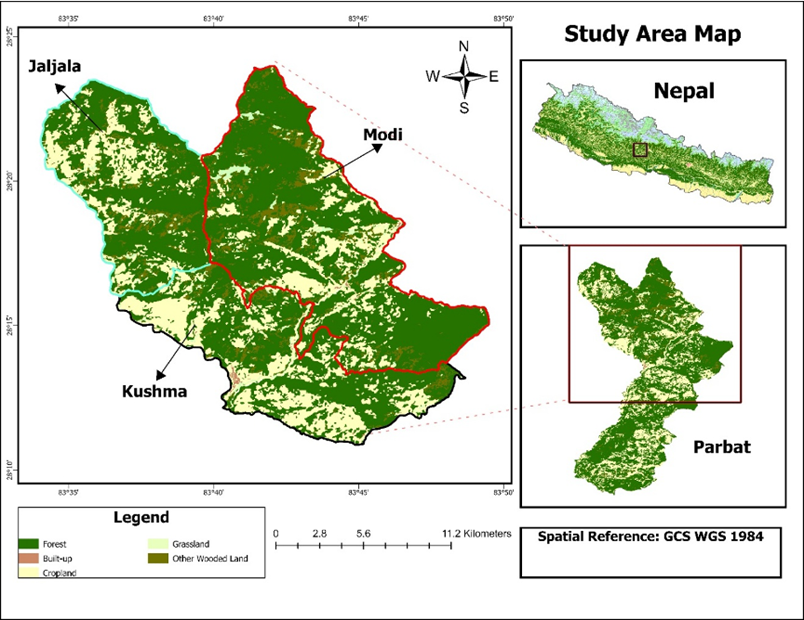
Image 1: Map of Parbat district, located in central Nepal (right) and three municipalities where research was conducted (left).
Why did you choose this location?
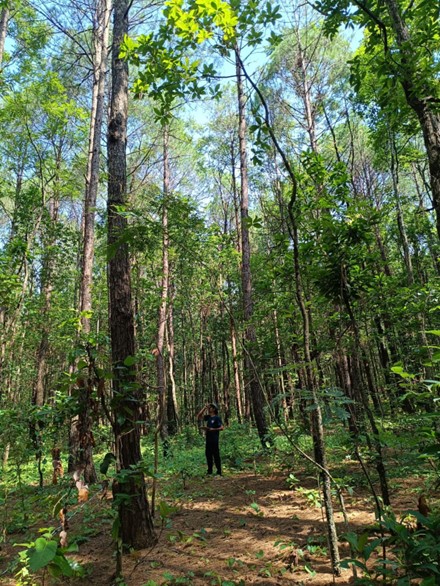
Parbat District represents a characteristic mid-hill landscape of Nepal, where agricultural land abandonment has become widespread due to rural outmigration and urbanization. I chose this area because it captures the ecological transitions that define much of the middle hills today — abandoned terraces gradually transforming into pine forests of varying ages. The region provided a clear gradient of successional stages, allowing me to examine how forest structure and composition evolve after cultivation ceases. Although many studies have tracked this land-use change through satellite imagery, there has been little ground-based ecological work. I wanted to bridge that gap by directly quantifying the forest attributes driving post-abandonment recovery.
What problem were you investigating?
I was investigating how forest composition and structure change following agricultural abandonment in the middle hills of Nepal. Specifically, I aimed to understand: (a) How does agricultural abandonment shape the structure and composition of regenerating pine forests? (b) How do different successional stages of pine regrowth affect forest biomass and carbon accumulation over time?
To answer these questions, I combined remote sensing and field ecology — using a 35-year chronosequence approach that integrated Landsat imagery (1990–2025) with detailed forest inventory data. Working across stands of different abandonment ages allowed me to visualize and measure how pine forests recover structurally and functionally through time.
Why does this question matter to you, and to the people you work with?
Forest regrowth on abandoned farmland is a dominant ecological process in the Himalayas, yet its role in carbon storage and biodiversity recovery remains understudied. Understanding these dynamics is essential for recognizing natural regeneration as a viable restoration pathway. For local communities, regenerating forests affect resource availability, soil stability, and land productivity. Quantifying their ecological value helps inform sustainable management and policy decisions under Nepal’s forest restoration and climate strategies.

What are the critical challenges facing your research site and the communities that are involved?
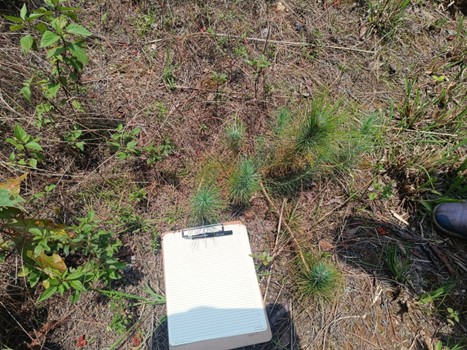
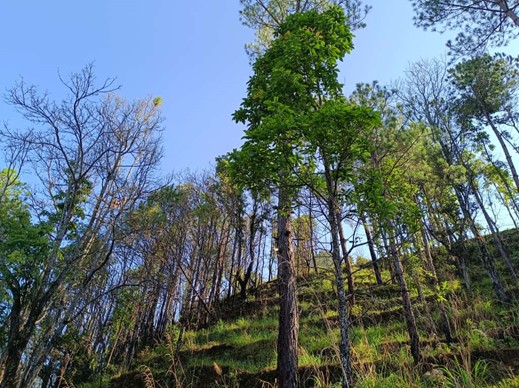
The regenerating pine forests of Parbat are often structurally simple and dominated by Pinus roxburghii, with limited understory development. Frequent surface fires, shallow soils, and low broadleaf recruitment restrict successional advancement. These ecological constraints make it difficult for forests to reach higher compositional and structural complexity. While my research did not directly engage with social dimensions, it was clear that changing land-use practices — such as reduced cultivation and grazing — indirectly influence forest dynamics. The challenge lies in understanding how these interacting ecological factors determine long-term forest stability and recovery potential.
Why do you love it?
I value this research because it explores fundamental ecological questions about succession and recovery in post-agricultural landscapes. Quantifying how structural and compositional attributes change over time provides insight into the mechanisms driving natural forest regeneration. The fieldwork also allowed me to observe successional transitions directly across sites of varying abandonment ages, translating theoretical understanding into measurable ecological patterns.
What do you think is needed to understand or improve the situation?
Advancing our understanding of post-abandonment succession requires integrating structural data with species-level functional traits. Quantifying attributes like wood density, shade tolerance, and growth rates can reveal why certain species dominate in early stages and how communities shift over time. Long-term ecological monitoring across chronosequences would improve predictions of biomass recovery and help identify thresholds that promote compositional diversification. These insights are essential for managing regenerating pine forests toward greater ecological complexity and long-term stability.
What challenges did you experience in your research?
Fieldwork in Parbat was both physically and logistically demanding. The terrain was steep and fragmented, and reaching some plots required long hikes through dense vegetation and eroded terraces. The monsoon season made access unpredictable, while distinguishing stand ages demanded careful integration of satellite imagery with field observations. Variations in site history introduced additional uncertainty, requiring detailed stratification and statistical adjustment. Despite these challenges, witnessing the ecological gradients firsthand made the findings more tangible and scientifically grounded.
How do you think your research may be used?
The findings provide a baseline for understanding successional dynamics, carbon accumulation, and structural development in pine-dominated secondary forests. They can inform management strategies that aim to accelerate natural succession — for instance, by identifying stand conditions favorable to broadleaf recruitment. On a broader scale, this research contributes to recognizing passive forest regeneration as a viable and cost-effective component of landscape-level restoration and carbon accounting efforts in the Himalayas.
Is there anything else you want to tell us?
The TRI fellowship allowed me to conduct field-based ecological research that directly addresses a critical knowledge gap in Nepal’s forest recovery science. The project strengthened my ability to integrate satellite analysis with ground-based ecology and to quantify long-term successional processes with precision. More importantly, it gave me the opportunity to engage deeply with a landscape that exemplifies the ecological consequences of land-use change in the Himalayas.