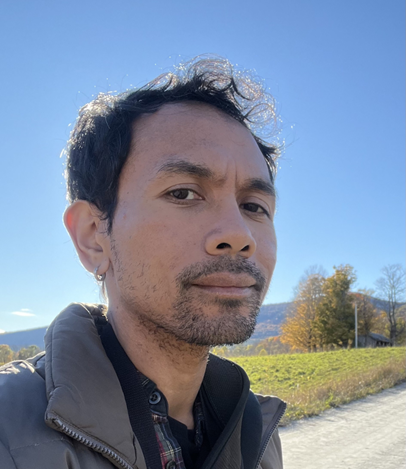
Where did you go for your fellowship?
This summer, I traveled to my home country of the Philippines to do multi-sited ethnographic fieldwork for my MESc thesis.

My two field assistants searching for giant clams in the shallow waters surrounding a stilt house built by one of our Molbog informants. These informal settlements are usually built several kilometers from the coast with materials sourced from inland forests, and for the purpose of supporting small-scale fishing and seaweed farming activities.
What problem were you investigating?
Using a political ecology lens, my research aims to gather the multiple perspectives involved in the harvesting, trade, and conservation of the endangered and CITES-regulated giant clam in the Philippines. In mid-June, I travelled to Palawan, a hotspot for confiscated clam shells.
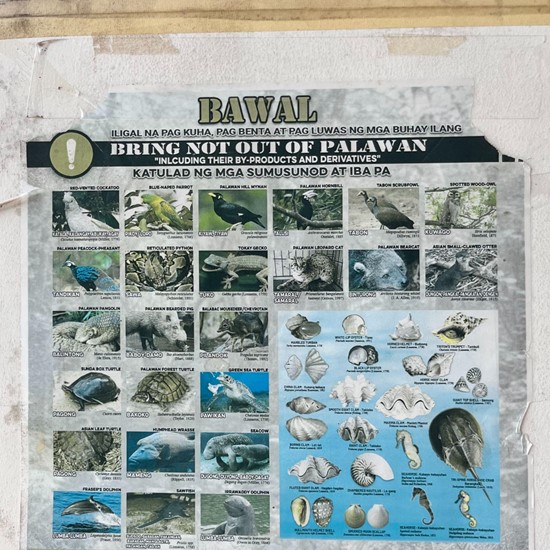
A poster of Palawan’s protected wildlife species. These posters are usually placed at seaports and airports meant to deter potential poachers.
Why did you choose this location?
While preparing my research proposal last semester, I decided to conduct most of my fieldwork in the municipality of Balabac, a small archipelago just south of mainland Palawan, where more recent confiscations occurred. My field assistants, two graduate students from the University of the Philippines, have been conducting social forestry research on the largest island (Balabac Island) for over three years and therefore served as valuable community entrées and local translators. There, I familiarized myself with the local government units, Department of Natural Resources, Bureau of Fisheries and Aquatic Resources, and Philippine Coast Guard—all of whom served as state level informants for my research. I also got to know the local coastal community members and ordinary citizens, as well as some of the indigenous Molbog peoples who lived further away from the town center. With these non-state actors, I tried to understand what the giant clam meant for them and how they felt about the policies implemented to protect giant clams.

A picture of me and one of my field assistants interviewing a group of Molbog elders in their ranngar (a community and religious gathering space).
My field assistants and I also traveled to more remote islands, known to be tourism hotspots and habitats for giant clams within Balabac’s municipality. I interviewed and observed tourists, tour guides, resort employees, and locals on these more distant and smaller islands to understand how the idea of insular remoteness and Balabac’s nascent tourism industry factor into the shifting value of the giant clam.

A picture of me interviewing a group of tourists from Cebu visiting Sebaring on Bugsuk Island, Balabac—a popular tourist destination.
Initially, my plan was to stay in Balabac. However, my field assistants encouraged me to explore other perspectives that could enrich and diversify my overall interpretation of the giant clam’s meaning and value. After leaving Balabac, I spoke with archaeologists in southern Palawan and the University of the Philippines, Diliman, and visited the national museums in Manila to learn more about the material culture of giant clams across the Philippines' deep history. I interviewed souvenir shop owners in Puerto Princesa and Manila to gauge their experiences in relation to local conservation regulations. I even secured a one-week appointment at the National Archives of the Philippines in Manila, where I gathered Spanish colonial era documents relating to Balabac's history, Sulu Sea trade, and marine resources, to better understand how the region’s colonial narratives inform the existing environmental and cultural politics of contemporary Balabac.

A picture of me with the pile of fossilized giant clam shells discovered on Bugsuk Island, Balabac in 2024, currently being held at a Coast Guard station in Sebaring, Bugsuk Island.
Is there anything else you want to tell us?
Overall, my summer research has veered off the path I planned for myself in my final proposal, going into unexpected territories that I never thought of exploring. However, that is the beauty of doing this type of work and something that my advisor, Michael Dove, encourages all his students to embrace: “Once you’re out in the field, don’t be guided by the strictures of your proposed questions, timelines and a priori theories. Let your natural curiosity take your research where it wants to go.” My job now is to make sense of everything I’ve observed and discovered from the field, with the aim of not only interrogating the flaws of blanket conservation policies, but to highlight competing narratives of blame, using the giant clam as a prism that reveals the multiplicity of environmental, social, and political conflicts occurring in Balabac today.