Where did you go for your fellowship?
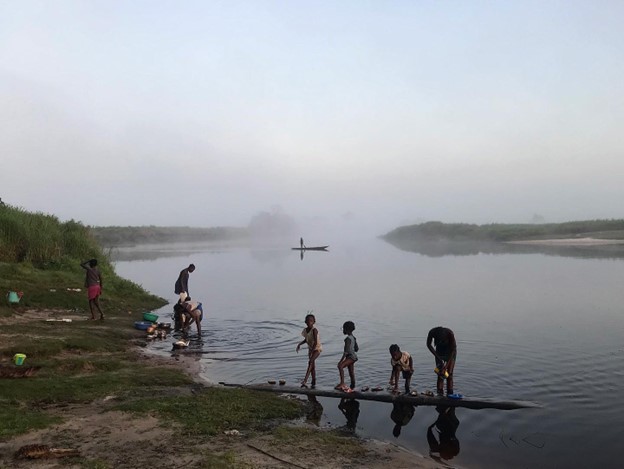
For my fellowship, I carried out my dissertation fieldwork in northern Republic of Congo. I worked within a protected area—the Lac Télé Community Reserve—that conserves an area of the Congo Basin’s seasonally-flooded peat swamp forests. It’s a site known for its high density of western lowland gorillas and for being the country’s only Community Reserve, home to over 20,000 people living across 27 riverine villages. My TRI funding also supported a supplementary research trip to the French Colonial archives in Aix en Provence, France, where my research collaborator and I examined 20th century administrative documents concerning Congo’s Lac Télé region.

Why did you choose this location?
As a transdisciplinary primatologist in the dual PhD program between anthropology and environmental studies, I chose this location due to its unique confluence of socio-political and biophysical characteristics. The site offered me the chance to study two sympatric great ape species (gorillas and chimpanzees) in an exceptionally data-poor environment: a seasonally-flooded forest where no sustained primatological research had been done. Beyond the pressures of living in a seasonally-flooded habitat, the reserve’s apes also have to navigate living in close proximity to hunting/fishing-dependent human communities. So, this location presented me with an opportunity to contribute important baseline data on great ape ecology and conservation using qualitative, participatory, and transdisciplinary methods—different from those that are typically employed at long-term primate research sites in strictly-protected national parks.
What problem were you investigating?
My research had two overarching goals: first, to examine the spatio-temporal dynamics of fruit production across the swamp forest’s sub-habitat types (dry forest, Raphia swamp, hardwood swamp, and riparian forest); second, to use ethnographic methods to better understand ape ecology, human-great ape relations, and socio-ecological change in the reserve.
Why does this question matter to you, and to the people you work with?
Due to environmental and anthropogenic pressures, great ape populations across Central Africa are in sharp decline. Meanwhile, from the few long-term study areas where researchers are observing sympatric gorillas and chimpanzees, we are constantly discovering new things about the behavioral ecology of these apes on a regular basis: how they survive in their (rapidly changing) environments, how they are able to coexist with each other, and how they coexist (or not) with people at a local to global scale.
My research was important to me first for its potential to contribute new data on the ecology of these two endangered species in a novel environment. Second, I was excited to learn more about and potentially contribute transdisciplinary solutions to help untangle the more social problems facing wildlife conservation in Central Africa. To make my research as relevant to and beneficial for the communities among whom I worked, I worked to apply a political ecology lens to my study of the reserve’s great apes. This means that, not only did I use local/traditional ecological knowledge as the basis for my investigation of forest ecology, fruit production, and ape behavioral ecology, I also broadened my study to investigate the political, economic, and socio-cultural histories of the region and its peoples, particularly as they related to the emergence and evolution of wildlife conservation management in the region. To do this, I added both an institutional ethnography (interviewing and observing conservation practitioners and other non-local site stakeholders) and an archival component to my (ethno)primatological study.

What are the critical challenges facing your research site and the communities that are involved?
Lac Télé is facing a number of environmental and political challenges. As a wetland-dominated habitat, it is simultaneously less researched and likely more at risk from climate and land-use change than surrounding non-wetland tropical forest regions. Being Congo’s only community reserve, it also faces the challenges inherent in attempting to achieve both sustainable human development and natural resource conservation in a rural but rapidly developing postcolonial African nation. The relationships between the reserve’s conservation stakeholders—NGO staff, Congolese government officials, and local/Indigenous community members— are fraught with tension, challenging effective policy development for this unique protected area and reproducing colonial-era dynamics of power surrounding natural resource governance and community autonomy.
Why do you love it?
I love my research for the opportunities it offers to travel to and help build conservation capacity in some of the most remote and at-risk environments in the world. I love the connections I form with the amazing people I get to work with, both locally and institutionally. Most of all, I love being outside every day and getting to explore and discover new things in these amazing tropical forest ecosystems.

What do you think is needed to understand or improve the situation?
My study region, and the entire Congo Basin forest system, need more investment in on-the-ground, transdisciplinary research that can illuminate fine-scale human-environment dynamics. So much of the research that is currently being invested in operates at huge scales (e.g. basin-wide climate modeling, landscape-scale animal density surveys) and is based either in the natural or social sciences rather than at the intersection of the two. While conservation globally is taking a social turn—more calls for knowledge pluralism, more justifications for studying relationships rather than things, more emphasis placed on ethical and co-produced research approaches, and more legitimacy given to Indigenous/local knowledge systems— these shifts are not well-reflected in Congo Basin research priorities and conservation interventions for a myriad of reasons. Recognizing and addressing the barriers to more transdisciplinary, collaborative research will also help researchers and practitioners shift towards producing data that can better address the complex socio-ecological problems playing out in this critical tropical forest region.
What challenges did you experience in your research?
Working in a peat swamp forest is not without its challenges. The hot and humid climate, means and efficacy of travel (boat), dearth of durable infrastructure or cultivatable land, etc. mean that living and doing research in these environments is especially complicated. At my research site in particular, there is generally no cell or internet service, electricity, running water, or most other amenities we in the US consider basic. The diversity and nutritional value of food is often poor with manioc and smoked fish being the staples. Due to the lack of a permanent research station or accessible market anywhere near where we were working, every excursion to a village or into the forest had to be planned meticulously in advance. My research teams (hired local men and my Congolese research collaborator, Tiriel) and I would have to pack everything we needed for a week or more in the forest on our backs, setting up camp in the least flooded areas we could find every evening.
In the forest, moreover, we had to be vigilant for all sorts of physical threats: cobras and pythons, swarming bees, a tree that, if touched, would swarm with aggressive biting ants, forest elephants. There was the ever-looming threat of malaria (I ended up getting it a week into a trip home for Christmas and, unfortunately, the Yale ER doctors had a hard time believing I had malaria and took 7 hours to diagnose/begin treating it), and other sicknesses… Giardia is a particularly unpleasant but common one that I contracted several times.

By and large, however, the largest problems Tiriel and I faced were social ones. I mentioned that the reserve’s communities have a tense relationship with conservation managers. Thus, as outside and foreign researchers, it would take us long periods of time to be accepted into and trusted by most of the village communities where we worked. Trying to mitigate while, at the same time, listening to and valorizing peoples’ (sometimes violent) anger during our ethnographic work was always challenging. Any choice we made (of which villages to work in, which people to hire as forest assistants, who to interview, etc.) was automatically ensnared in a mesh of existing inter-village, inter-familial, historical conflicts. The village communities where we worked, however, were ultimately very welcoming to us and happy to have a platform through which to voice their knowledge, concerns, and hopes.
How do you think your research may be used?
My research will offer baseline data as a jumping-off point for many further ecological and social studies in the reserve and its surrounding swamp forest region. It also suggests practical changes to make for improved conservation outcomes in the reserve—ones that account for the place-based histories, uneven power dynamics, and biocultural relationships that have shaped the area that makes up the reserve today.