Where did you go for your fellowship?
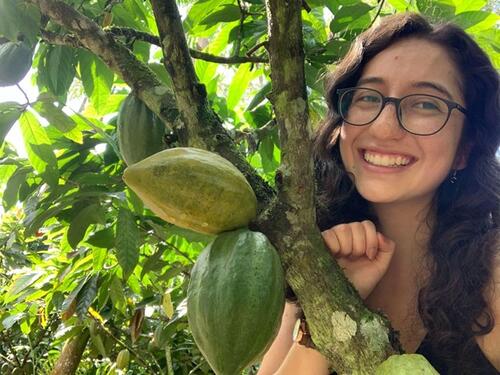
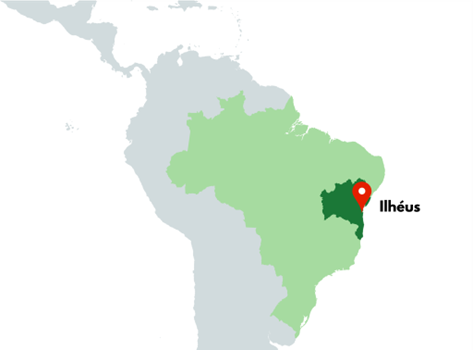
I spent my summer in Ilhéus, a coastal town in the state of Bahia, southeastern Brazil. I worked in cabrucas —shaded cacao agroforestry systems — at Fazenda Dengo Origem, owned by Dengo, one of Bahia’s most celebrated chocolate brands. Cabrucas are a fascinating system where cacao trees grow under the shade of native tree species, creating a unique ecosystem that blends agriculture and biodiversity in a unique way.
Why did you choose this location?
Bahia holds tremendous ecological and economic importance. It is one of Brazil’s main cacao-producing regions and a recognized biodiversity hotspot, home to an extraordinary number of endemic species. Some of the last remaining fragments of the Atlantic Forest still persist here — small patches that blend seamlessly with agroforestry systems.
Working in this region allowed me to see firsthand how production and conservation can coexist, side by side, in one of the most biologically rich yet threatened ecosystems of the tropics.

What problem were you investigating?
I wanted to understand how cabruca systems change over time — not only in terms of the biomass they store but also the biodiversity they sustain. Cabrucas are shaded cacao agroforestry systems where cacao trees grow beneath a canopy of native species. They are often considered low-impact agricultural systems, yet their ecological dynamics remain largely understudied.
My goal was to look beyond the number of species and explore how these systems are diverse in a functional sense — how species coexist, interact, and sustain one another. I focused on pollination and seed-dispersal syndromes, seeking to understand what kinds of ecological interactions are maintained within these systems and how they change over time.

Why does this question matter to you, and to the people you work with?
Most people think of biodiversity simply as the number of species in a place. But I’ve come to believe that this isn’t an accurate measure of the health or functioning of an ecosystem. After working several years in tropical forests, I’ve realized that species interactions — the ways organisms depend on and influence one another — are the real foundation of ecological integrity. Understanding these interactions offers a much clearer picture of an ecosystem’s status than species counts alone.
Today, there is an urgent push to quantify biodiversity in order to design economic strategies that can finance conservation. Yet, this has proven to be an almost impossible task. I don’t think biodiversity can ever be fully “measured” or reduced to a single value — it’s too complex, too alive. But I believe there are new ways to represent and value it, and my research is a small step toward exploring that possibility.
What are the critical challenges facing your research site and the communities that are involved?
Talking with the people who work at Fazenda Dengo Origem, I learned that trust is one of the biggest challenges. Because cabrucas aim to balance conservation and cacao production, they are often seen as promising systems for developing biodiversity-based payment models. Yet, many small farmers remain uncertain about participating in these initiatives. They worry about outsiders entering their properties, setting rules, or imposing management plans that could interfere with their productivity and autonomy.
Building trust and showing that these initiatives can bring long-term benefits — not just ecological but also economic — is essential. Conservation cannot succeed without the confidence and participation of local communities.
Why do you love it?
Coming from a background rooted in natural and theoretical ecology, I loved stepping into a more applied and interdisciplinary environment. Working in agroforestry took me out of my comfort zone — I began thinking not just as an ecologist but also as a farmer, learning to appreciate the complexity and magic of these managed ecosystems. It opened my eyes to how science and practice can come together, and how collaboration between disciplines can generate innovative ways to protect nature while supporting livelihoods.
What do you think is needed to understand or improve the situation?
We need more communication and collaboration — across disciplines and with the people who live and work in these landscapes. Understanding local needs and concerns is the first step and sharing scientific findings in accessible and meaningful ways is just as important.
We also need to think about the future of these systems: What will they look like decades from now? Will they still sustain the same ecological functions and support diverse species over time? Scientists from different backgrounds must work together to design management strategies that are both ecologically sound and socially inclusive — approaches that honor both the forest and the people who depend on it.
What challenges did you experience in your research?
Agroforestry was a completely new field for me, and I had to learn quickly how these systems function — not only from an ecological perspective but also from an agricultural one. It challenged me to step outside my comfort zone, to see through the eyes of farmers, and to adapt my scientific mindset to a more practical and human context.
How do you think your research may be used?
My findings suggest that these agroforestry systems remain relatively stable over time in terms of biomass and structure. This stability can be positive — showing resilience and predictability — but it also raises questions about regeneration and long-term sustainability.
The results highlight the need for long-term monitoring to understand not only carbon and biomass dynamics but also ecosystem functionality — how species interactions and ecological processes evolve over time.
Is there anything else you want to tell us?
When we talk about conservation, we can’t forget about people. In a rapidly changing world, we must find ways to reconcile production and environmental protection. Agroforestry might not be a perfect solution, but it offers a promising path forward — a way to integrate biodiversity, livelihoods, and climate resilience, and a space where initiatives like biodiversity payments can begin to take shape. There is no single way to achieve this balance. Agroforestry and cabrucas may not be the only answer, but they are a very good place to start.